Probabilistic genotyping is one of the newly developed DNA algorithms used to catch criminal suspects. Probabilistic genotyping is when DNA collected as evidence is compared to the DNA of a person of interest. With this new technology in play, it has been made possible for cold cases to be revisited. The advancement of DNA technology has allowed for cold cases to be re-opened and solved, allowing for the families of the victims to feel some form of relief.
The newly advanced DNA technology has changed law enforcement dramatically for the better. “Baker’s mother, Sue Baker, who virtually attended Harrison’s hearing in Stafford County Wednesday, called the developments in the case “surreal” and the advancements in forensic science “incredible.”” 1The three primarily used forensic algorithms are probabilistic genotyping, latent print analysis, and facial recognition. If DNA such as blood, hair, or semen is left at a crime scene, it is carefully collected to make sure that it doesn’t get contaminated during the process. Once the DNA is collected, it is tested to see if it is a match to the person of interest. This process is much more reliable than the more traditional methods used by law enforcement. Testimony from witnesses can be unreliable due to them forgetting information, being wrong about what they saw, or many other factors that could cause them to provide misinformation. DNA testing is less circumstantial. Revisiting these old cold cases with new technology has eliminated the reason why they became cold cases in the first place.
Jacqueline Lard and Amy Baker are two examples of cold cases being solved due to DNA technology. Elroy Neal Harrison was caught because a relative of his had done a DNA test on Ancestry.com. That relative’s DNA profile was used to research their family tree. This led to Harrison being caught and arrested. Solving these cold cases has allowed for the families of the victims to feel a sense of relief. “”we never expected this” Sue Baker said. “I never gave up. I told her I’d never give up.””2 Sue Baker is Amy Baker’s mother. She was part of the group who went out to look for Amy.
- Jackson and Chris Boyette, “Man Arrested.” ↩︎
- Jackson and Chris Boyette, “Man Arrested.”
↩︎ - U.S. Government Accountability Office, DNA Analysis: Federal Efforts to Enhance the National DNA Database, GAO-24-107206, Hearing on January 24, 2024, Committee on the Judiciary, U.S. Senate, https://www.gao.gov/assets/d24107206.pdf. ↩︎
- G. M. Kirkpatrick, T. D. Davis, K. L. Rojas, and S. M. J. Lane, “Ethical Considerations in the Use of DNA in Criminal Justice,” Journal of Forensic Sciences 63, no. 3 (2018): 818-823, https://pmc.ncbi.nlm.nih.gov/articles/PMC6123268/. ↩︎
- Kirkpatrick et al., “Ethical Considerations,” 818. ↩︎
- Kirkpatrick et al., “Ethical Considerations,” 818. ↩︎
In the video above, Mark and Sue Baker speak on their experience and feelings on Amy’s case. Sue talks about how she would continue to call, asking for updates and information on the investigation. Both Mark and Sue share how they feel after Harrison was caught after all of these years. It’s not true closure considering what happened to their daughter, but there is a form of relief knowing that the man who murdered her has finally been caught.
While it is true that DNA technology has many benefits in solving cold cases, there are some issues that can make the process very difficult. “Probabilistic genotyping algorithms compare collected DNA evidence (e.g., from blood, hair) to DNA samples from persons of interest. Such algorithms can assess a wider range of DNA samples than conventional methods but face some challenges. For example, it can be difficult to interpret or explain the results, and some experts told GAO that insufficient scientific studies have been conducted to fully validate their use for samples containing DNA from multiple people.”3
The results of a DNA test are does not give you an exact answer. This makes the process of tracking down a specific individual in a family tree very challenging. To explain the process, I’ve posted my own DNA test down below.
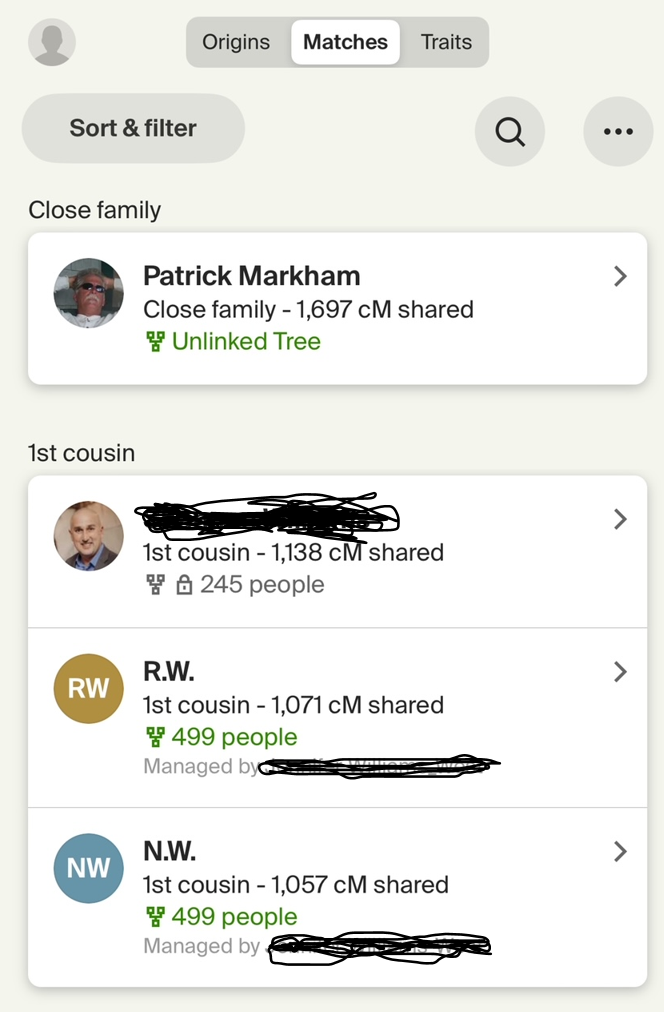
This is a picture of my Ancestry.com results. The categories go from close family, 1st cousin, 2nd cousin, 3rd cousin, to 4th cousin. It does not give you a match’s exact relation to you. The match under “close family” is my grandfather on my mother’s side, but the results won’t be that specific. My matches under “1st cousin” is wrong completely. Two of them are my great uncles on my father’s side and the top match is my half uncle on my mother’s side. The test looks for the amount of cM you share with someone. cM is a unit of measurement used in DNA. It stands for centimorgan. The more cM you share with someone, the more closely you are related. My half uncle shares more cM with me than my two full blooded great uncles. If a suspect didn’t have any “close family” or “1st cousin” matches, it would be very difficult to track them down using this method. The cM count drops dramatically from 1st cousin to 2nd cousin. Going through this process to identify a suspect under investigation would be considered “investigative genetic genealogy”.
Other problems that come with DNA testing used by law enforcement are ethical problems such as privacy, informed consent, and wrongful convictions. “Many companies do not inform users that their information may be subject to forensic analysis. Others mention it in their terms of service, but whether users internalize (or even read) these documents is in considerable doubt.”4 Many people who upload their DNA online aren’t fully aware of who can use it and how it can be used. People are unaware that a DNA test they did for fun could lead to the arrest of one of their family members if they committed a crime. This is exactly what lead to Elory Neal Harrison being caught and arrested. If a suspect left some form of DNA evidence at a crime scene, the “abandonment doctrine” legal theory would be applied. This legal theory states that the suspect has no “reasonable expectation of privacy” in abandoned materials.5 Evidence obtained through this method is admissible in court.
DNA testing doesn’t always bring accurate results. If the DNA of a certain individual is collected at a crime scene, that does not necessarily mean that they were there at the same time as when the crime had taken place. It also doesn’t prove that they are guilty of committing this crime. All that has been proven is that this person was at the same location at some point in time. “The reliability of DNA evidence also raises justice concerns. Prosecutors and courts might overinterpret or misuse genetic identification as a source of evidence. DNA evidence demonstrates only that an individual’s genetic material was found at a given location, not that the person was present during, or indeed guilty of, the crime. Further, evidence may be compromised if collected without extraordinary care. In a murder case in Germany, genetic analysis of evidence collected with a contaminated cotton swab led police to erroneously target Romani (“gypsy”) communities for 2 years.”6 It is recommended that DNA testing should be used as a tool instead of the primary source of evidence.
Despite the complications involved, it is well worth it to use DNA testing to re-open and solve cold cases. The Baker family are my cousins, and I saw firsthand how Amy’s family reacted to the news of Harrison being caught. My mother was only eight years old when Amy was murdered, and it was like a weight being lifted off her shoulders knowing that the man who did it was finally caught and being punished. Imagine how Sue Baker, Amy’s mother felt. Imagine how you would feel if it was your daughter or someone else you cared for. The advancement of DNA testing has made it possible to re-visit these cold cases and solve them, bringing a sense of relief to the families of the victims.